Showing posts with label Articles. Show all posts

The History of Chevrolet

Monday, August 3, 2009

General Motors owns Chevrolet, a great American car manufacturer. W.C. Durant in Detroit, Michigan started the company. The cars produced were first brought out by racecar driver, Louis Chevrolet. He established an automobile for $2150, which were six cylinders and 4.9 litres. The first big car produced on the market was the Baby Grand, which was sold for $875. Electrics were optional on Chevrolets until 1917. With the first real boost in production and innovation cars were sold at a standard price increasing sales to 70,701 from 13,600.

In 1917 General Motors acquired Chevrolet. In 1920 Ford and Dodge were the only leaders above Chevrolet's marque. As competition rose Chevrolet began preparation for new models as well as styles. They came up with a few standard automobiles, which were no different than competitors until their 1925 Superior. This coach had disc wheels and "Duco cellulose finish (refer to source 6)" selling for only $650. This allowed for Chevrolet to outsell Ford for the first time, even though Ford was switching over from the Model T to A. One big development came in 1929 with the "Cast Iron Wonder" which sold more than a million cars in its first year at $595.

In 1931 Chevrolet finally surpassed Ford for a matter of 3 years. During the 1930's Chevy became aware of the need to improvise. They came up with many new styles adding to their collection of automobiles. Thy created V-grilles, hydraulic brakes, large engines, column shifts, along with convertibles. They also manufactured a station wagon in 1939. While in 1940 they offered a power top convertible with low prices. Also during the coming months Juan Manuel Fangio won a race in Argentina using one of the new coupes.

As years passed the company increased sales, production, and opportunities. In 1949 they underwent surgery on their cars by extensively restyling to produce a sedan costing $1460. A major impact came in 1950 with the offering of a 2 speed fully automatic transmission. In 1953 the Corvette sports car was produced with a V-6 and fiberglass body.

The Corvette was a spectacular automobile. It needed more so it was reassembled to acquire an 8-cylinder engine with options such as air suspension. Another breakthrough car was the 1960 Corvair, which was reproduced to include a turbo-supercharged engine.

The Chevrolet Company has produced many new models over the years. They have become a leader in the industry under General Motors. With newer models of sports cars, full size pickup trucks, sedans, and coupes the company has grown with immense popularity. The company proved the need of American manufacturers to diversify their products. They improved using new styles such as disc brakes, headlamps, engine size, faster, as well as more reliable cars. Some of their greatest accomplishments were the Camaro, Corvette, the luxurious Caprice, Chevelle, and the Impala. Chevrolet has always been a competitor; they produce in order to satisfy the needs of the consumer by offering great automobiles at low prices.

History of Ford Motor Company

Ford was launched in a converted factory in 1902 with $31,000 in cash (approximately US$687 thousand, adjusted for inflation) from twelve investors, most notably John and Horace Dodge, who would later found the Dodge Brothers Motor Vehicle Company. Henry Ford was 40 years old when he founded the Ford Motor Company, which would go on to become one of the largest and most profitable companies in the world, as well as being one of the few to survive the Great Depression. The largest family-controlled company in the world, the Ford Motor Company has been in continuous family control for over 100 years.

During its early years, the company produced a range of vehicles designated, chronologically, from the Ford Model A (1903) to the Model K and Model S (Ford's last right-hand steering model)[1] of 1907.[2] The K, Ford's first six-cylinder model, was knows as "the gentleman's roadster" and "the silent cyclone", and sold for US$2800 (approximately US$63.8 thousand, adjusted for inflation);[3] by contrast, around that time, the Enger 40 was priced at US$2000,[4] the Colt Runabout US$1500,[5] the high-volume Oldsmobile Runabout[6] US$650, Western's Gale Model A US$500,[7] and the Success hit the amazingly low US$250 (approximately US$5.7 thousand, adjusted for inflation).[8]

The next year, Henry Ford introduced the Model T. Earlier models were produced at a rate of only a few a day at a rented factory on Mack Avenue in Detroit, Michigan, with groups of two or three men working on each car from components made to order by other companies (what would come to be called an "assembled car"). The first Model Ts were built at the Piquette Road Manufacturing Plant, the first company-owned factory. In its first full year of production, 1909, about 18,000 Model Ts were built. As demand for the car grew, the company moved production to the much larger Highland Park Plant, and in 1911, the first year of operation there, 69,762[9] Model Ts were produced, with 170,211 in 1912.[10] By 1913, the company had developed all of the basic techniques of the assembly line and mass production. Ford introduced the world's first moving assembly line that year, which reduced chassis assembly time from 12½ hours in October to 2 hours 40 minutes (and ultimately 1 hour, 33 minutes),[11] and boosted annual output to 202,667 units that year[12] After a Ford ad promised profit-sharing if sales hit 300,000 between August 1914 and August 1915,[13] sales in 1914 hit 308,162, and 501,462 in 1915;[14] by 1920, production would exceed one million a year.

These innovations were hard on employees, and turnover of workers was very high, while increased productivity actually reduced labor demand.[15] Turnover meant delays and extra costs of training, and use of slow workers. In January 1914, Ford solved the employee turnover problem by doubling pay to $5 a day, cutting shifts from nine hours to an eight hour day for a 5 day work week (which also increased sales; a line worker could buy a T with less than four months' pay),[16] and instituting hiring practices that identified the best workers, including disabled people considered unemployable by other firms.[17] Employee turnover plunged, productivity soared, and with it, the cost per vehicle plummeted. Ford cut prices again and again and invented the system of franchised dealers who were loyal to his brand name. Wall Street had criticized Ford's generous labor practices when he began paying workers enough to buy the products they made.[18]
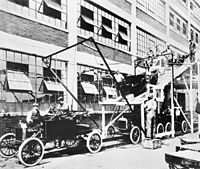
Ford assembly line (1913)

While Ford attained international status in 1904 with the founding of Ford of Canada, it was in 1911 the company began to rapidly expand overseas, with the opening of assembly plants in England and France, followed by Denmark (1923), Germany (1925), Austria (1925),[19] and Argentina (1925),[20] and also in South Africa (1924)[21] and Australia (1925) as subsidiaries of Ford of Canada due to preferential tariff rules for Commonwealth countries. By the end of 1919, Ford was producing 50 percent of all cars in the United States, and 40% of all British ones;[22] by 1920, half of all cars in the U.S. were Model Ts. (The low price also killed the cyclecar in the U.S.)[23] The assembly line transformed the industry; soon, companies without it risked bankruptcy. Of 200 U.S. car makers in 1920, only 17 were left in 1940.[24]
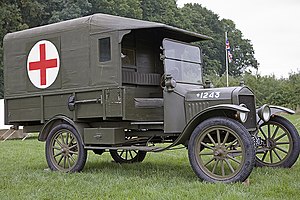
Ford 1916 Model T Field Ambulance. This canvas on wood frame model was used extensively by the British & French as well as the American Expeditionary Force in World War I. Its top speed was 45 mph (72 km/h), produced by a 4 cylinder water cooled engine

It also transformed technology. Henry Ford is reported to have said, "Any customer can have a car painted any color that he wants so long as it is black." Before the assembly line, Ts had been available in a variety of colors, including red, blue, and green, but not black. Now, paint had become a production bottleneck; only Japan Black dried quickly enough, and not until Duco lacquer appeared in 1926 would other colors reappear on the T.[25]

In 1915, Henry Ford went on a peace mission to Europe aboard a ship, joining other pacifists in efforts to stop World War I. This led to an increase in his personal popularity. Ford would subsequently go on to support the war effort with the Model T becoming the underpinnings for Allied military vehicles, like the Ford 3-Ton M1918 tank, and the 1916 ambulance.

History of the blue oval

The Ford oval trademark was first introduced in 1907. The 1928 Model A was the first vehicle to sport an early version of the Ford script in the oval badge. The dark blue background of the oval is known to designers as Pantone 294C. The Ford script is credited to Childe Harold Wills, Ford's first chief engineer and designer. He created a script in 1903 based on the one he used for his business cards. Today, the oval has evolved into a perfect oval with a width-to-height ratio of 8:3. The current Centennial Oval was introduced on June 17, 2003 as part of the 100th anniversary of Ford Motor Company.[26]

Post-World War I developments

In 1919, Edsel Ford succeeded his father as president of the company, although Henry still kept a hand in management. Although prices were kept low through highly efficient engineering, the company used an old-fashioned personalized management system, and neglected consumer demand for improved vehicles. So, while four wheel brakes were invented by Arrol-Johnson (and were used on the 1909 Argyll),[27] they did not appear on a Ford until 1927. (To be fair, Chevrolet waited until 1928.)[28] Ford steadily lost market share to GM and Chrysler, as these and other domestic and foreign competitors began offering fresher automobiles with more innovative features and luxury options. GM had a range of models from relatively cheap to luxury, tapping all price points in the spectrum, while less wealthy people purchased used Model Ts. The competitors also opened up new markets by extending credit for purchases, so consumers could buy these expensive automobiles with monthly payments. Ford initially resisted this approach, insisting such debts would ultimately hurt the consumer and the general economy. Ford eventually relented and started offering the same terms in December 1927, when Ford unveiled the redesigned Model A, and retired the Model T after producing 15 million units.

Lincoln Motor Company

On February 4, 1922 Ford expanded its reach into the luxury auto market through its acquisition of the Lincoln Motor Company, named for Abraham Lincoln whom Henry Ford admired, but Henry M. Leland had named the company in 1917. The Mercury division was established in 1938 to serve the mid-price auto market.[29] Ford Motor Company built the largest museum of American History in 1928, The Henry Ford.

Henry Ford would go on to acquire Abraham Lincoln's chair, which he was assassinated in, from the owners of the Ford Theatre. Abraham Lincoln's chair would be displayed along with John F. Kennedy's Lincoln limousine in the Henry Ford Museum & Greenfield Village in Dearborn, known today as The Henry Ford. Kennedy's limousine was leased to the White House by Ford.

Fordlândia

In 1928, Henry Ford negotiated a deal with the government of Brazil for a plot of land in the Amazon Rainforest. There, Ford attempted to cultivate rubber for use in the company's automobiles. After considerable labor unrest, social experimentation, and a failure to produce rubber, and after the invention of synthetic rubber, the settlement was sold in 1945 and abandoned.

The Great Depression

During the great depression, Ford in common with other manufacturers, responded to the collapse in motor sales by reducing the scale of their operations and laying off workers. By 1932, the unemployment rate in Detroit had risen to 30%[30] with thousands of families facing real hardship. Although Ford did assist a small number of distressed families with loans and parcels of land to work, the majority of the thousands of unskilled workers who were laid off were left to cope on their own. However, Henry Ford angered many by making public statements that the unemployed should do more to find work for themselves.

This led to Detroit’s Unemployed Council organizing the Ford Hunger March. On March 7, 1932 some 3,000 - 5,000 unemployed workers assembled in West Detroit to march on Ford's River Rouge plant to deliver a petition demanding more support. As the march moved up Miller Road and approached Gate 3 the protest turned ugly. The police fired tear gas into the crowd and fire trucks were used to soak the protesters with icy water. When the protesters responded by throwing rocks, the violence escalated rapidly and culminated in the police and plant security guards firing live rounds through the gates of the plant at the unarmed protesters. Four men were killed outright and a fifth died later in hospital. Up to 60 more were seriously injured.[31]

Soviet Fords and the Gorki

In May 1929 the Soviet Union signed an agreement with the Ford Motor Company. Under its terms, the Soviets agreed to purchase $13 million worth of automobiles and parts, while Ford agreed to give technical assistance until 1938 to construct an integrated automobile-manufacturing plant at Nizhny Novgorod. Many American engineers and skilled auto workers moved to the Soviet Union to work on the plant and its production lines, which was named Gorkovsky Avtomobilny Zavod (GAZ), or Gorki Automotive Plant in 1932. A few American workers stayed on after the plant's completion, and eventually became victims of Stalin's Great Terror, either shot[32] or exiled to Soviet gulags.[33] In 1933, the Soviets completed construction on a production line for the Ford Model-A passenger car, called the GAZ-A, and a light truck, the GAZ-AA. Both these Ford models were immediately adopted for military use. By the late 1930s production at Gorki was 80,000-90,000 "Russian Ford" vehicles per year. With its original Ford-designed vehicles supplemented by imports and domestic copies of imported equipment, the Gorki operations eventually produced a range of automobiles, trucks, and military vehicles.

World War II

President Franklin Roosevelt referred to Detroit as the "Arsenal of Democracy." The Ford Motor Company played a pivotal role in the allied victory during World War I and World War II. As a pacifist, Henry Ford had said war was a waste of time, and did not want to profit from it. He was concerned the Nazis during the 1930s might nationalize his factories in Germany. During the Great Depression Ford's wages may have seemed great to his employees but many of the rules of the factories were very harsh and strict. Those were tense times for American companies doing business in Europe. In the spring of 1939, the Nazis assumed day to day control of Ford factories in Germany.

With Europe under siege, Henry Ford's genius would be turned to mass production for the war effort. After Bantam invented the Jeep, the War Department handed production over to Ford and Willys. When Consolidated Aircraft could at most build one B-24 Liberator a day, Ford would show the world how to produce one an hour, at a peak of 600 per month in 24 hour shifts. The specially-designed Willow Run plant broke ground in April 1941. At the time, it was the largest assembly line in the world, with over 3,500,000 square feet (330,000 m2) under one roof. Edsel Ford, under severe stress, died in the Spring of 1943 of stomach cancer, prompting his grieving father to resume day-to-day control of Ford. Mass production of the B-24 began by August 1943. Many pilots slept on cots waiting for takeoff as B-24s rolled off the line.[34]

In the United Kingdom, Ford built a new factory in Trafford Park, Manchester during WW2 where over 34,000 Rolls-Royce Merlin aero engines were completed by a workforce trained from scratch.

Post-World War II developments

At the behest of Edsel Ford's widow Eleanor and Henry's wife Clara, Henry Ford would make his oldest grandson, Henry Ford II, President of Ford Motor Company.
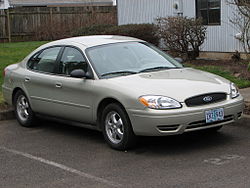
A Ford Taurus, one of Ford's best-selling models. In its 21 year lifespan, it sold 7,000,000 units. It is the 4th best selling car in Ford's history, behind only the F-150, the Model T, and the Mustang.

Henry Ford II served as President from 1945–1960, and as Chairman and CEO from 1960–1980. "Hank the Deuce" led Ford to become a publicly traded corporation in 1956. However, the Ford family maintains about 40 percent controlling interest in the company, through a series of Special Class B preferred stocks.

In 1947, Henry Ford died. According to A&E Biography, an estimated 7 million people mourned his death.

Ernest R. Breech was hired in 1946 and became the Executive Vice President, and became Board Chairman in 1955.

In 1946, Robert McNamara joined Ford Motor Company as manager of planning and financial analysis. He advanced rapidly through a series of top-level management positions to the presidency of Ford on 9 November 1960, one day after John F. Kennedy's election. The first company head selected outside the Ford family, McNamara had gained the favor of Henry Ford II, and had aided in Ford's expansion and success in the postwar period. Less than five weeks after becoming president at Ford, he accepted Kennedy's invitation to join his cabinet, as Secretary of Defense.

In the 1950s, Ford introduced the iconic Thunderbird in 1955 and the Edsel brand automobile line in 1958. Edsel was cancelled after less than 27 months in the marketplace in November 1960. The corporation bounced back from the failure of the Edsel by introducing its compact Ford Falcon in 1960 and the Mustang in 1964. By 1967, Ford of Europe was established.

Lee Iacocca was involved with the design of several successful Ford automobiles, most notably the Ford Mustang. He was also the "moving force," as one court put it, behind the notorious Ford Pinto. He promoted other ideas which did not reach the marketplace as Ford products. Eventually, he became the president of the Ford Motor Company, but he clashed with Henry Ford II and ultimately, on July 13, 1978, he was famously fired by Henry II, despite Ford posting a $2.2 billion dollar profit for the year. He was subsequently hired by the Chrysler Corporation, of which he pulled his famous turnaround in the 1980s. In 1979 Philip Caldwell became Chairman, succeeded in 1985 by Donald Petersen.

Harold Poling served as Chairman and CEO from 1990-1993. Alex Trotman was Chairman and CEO from 1993-1998, and Jacques Nasser served at the helm from 1999-2001. Henry Ford's great-grandson, William Clay Ford Jr., is the company's current Chairman of the Board and was CEO until September 5, 2006, when he named Alan Mulally from Boeing as his successor. As of 2006, the Ford family owns about 5 percent of Ford's shares and controls about 40 percent of the voting power through a separate class of stock.[35]

Current Ford CEO Alan Mulally, who was hired by William Clay Ford, Jr. to restructure the company.

In December 2006, Ford announced that it would mortgage all assets, including factories and equipment, office property, intellectual property (patents and trademarks), and its stakes in subsidiaries, to raise $23.4 billion in cash. The secured credit line is expected to finance product development during the restructuring through 2009, as the company expects to burn through $17 billion in cash before turning a profit. The action was unprecedented in the company's 103 year history.[36]

General corporate timeline
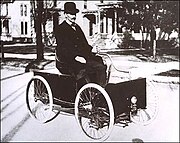
Henry Ford and the Quadricycle
1896 Quadricycle at The Henry Ford Museum in Dearborn, MI
1903 Ford Model A
Ford Model T ad - ca 1908
1930 Ford Model A Fordor
The Ford Australia plant under construction in Geelong, Victoria, Australia, 1926
Mustang Serial #1 - The First Mustang
Ford provides Econoline framework chasses for ambulances
  • 1896: Henry Ford builds his first vehicle – the Quadracycle – on a buggy frame with 4 bicycle wheels.
  • 1898: Henry Ford creates the Detroit Automobile Company; two and a half years later it is dissolved.
  • 1901: Henry Ford wins high-profile car race in Grosse Pointe, Mi
  • 1901: The Henry Ford Company is incorporated but discontinued the following year only to be reinvigorated by Henry Leland as the Cadillac Motor Company
  • 1903: Ford Motor Company incorporated with 11 original investors. The original Model A "Fordmobile" is introduced - 1,708 cars are produced.
  • 1904: Ford Motor Company of Canada incorporated in Walkerville, Ontario
  • 1904: Henry Ford teams up with Harvey Firestone of Firestone Tires
  • 1906: Ford becomes the top selling brand in the US, with 8,729 cars produced.
  • 1908: Model T is introduced. 15 million are produced through 1927.
  • 1909: Ford Motor Company (England) established, otherwise referred to as Ford of Britain
  • 1911: Ford opens first factory outside North America – in Manchester, England.
  • 1913: The moving assembly line is introduced at Highland Park assembly plant, making Model T production 8 times faster.
  • 1913: Ford opens second world branch in Argentina as Ford Motor Argentina
  • 1914: Ford introduces $5 ($106, adjusted for inflation) workday minimum wage – double the existing rate.
  • 1918: Construction of the Rouge assembly complex begins.
  • 1919: Edsel Ford succeeds Henry as Company President.
  • 1921: Ford production exceeds 1 million cars per year, nearly 10 times more than Chevrolet - the next biggest selling brand.
  • 1922: Ford purchases Lincoln Motor Company for US $8 million ($102 million, adjusted for inflation).
  • 1925: Ford introduces Ford Tri-Motor airplane for airline services
  • 1926: Ford Australia is founded in Geelong, Victoria, Australia.
  • 1927: Model T production ends, Ford introduces the next generation Model A, from the Rouge complex.
  • 1929: Ford regains production crown, with production peaking at 1.5 million cars
  • 1931: Ford and Chevy brands begin to alternate as US production leaders, in battle for automobile sales during the Great Depression.
  • 1932: Ford introduces the one-piece cast V8 block.
  • 1936: Lincoln-Zephyr is introduced.
  • 1938: The German consul at Cleveland gave Henry Ford the award of the Grand Cross of the German Eagle, the highest medal Nazi Germany could bestow on a foreigner. There is some evidence that Henry Ford had Nazi sympathies, at least before World War II. He may have financed some Nazi activities, and was active in anti-semitic efforts.
  • 1939: Mercury division is formed to fill the gap between economical Fords and luxury Lincolns. Operated as a division at Ford until 1945
  • 1941: The Lincoln Continental is introduced. Ford begins building general purpose "jeep" for the military. First labor agreement with UAW-CIO covers North American employees.
  • 1942: Production of civilian vehicles halted, diverting factory capacity to producing B-24 Liberator bombers, tanks, and other products for the war effort.
  • 1943: Edsel Ford dies of cancer at the age of 49, Henry Ford resumes presidency.
  • 1945: Henry Ford II becomes president.
  • 1945: Lincoln and Mercury are combined into a single division.
  • 1946: Ford sues the allies for damages done to his factories in Dresden during the infamous bombing, and wins compensation.
  • 1946: The Whiz Kids, former US Army Air Force officers, are hired to revitalize the company. Automobile production resumes.
  • 1947: Henry Ford dies of cerebral hemorrhage at the age of 83; Henry Ford II becomes new chairman.
  • 1948: F-1 Truck introduced. Lincoln Continental is introduced.
  • 1949: The '49 Ford introduces all-new post-war era cars. The "Woody" station wagon is introduced.
  • 1953 Ford Canada Headquarters and Car Plant opens in Oakville, Ontario
  • 1954: Thunderbird introduced as a personal luxury car with a V8. Ford begins crash testing, and opens Arizona Proving Grounds.
  • 1956: $10,000 ($79.3 thousand, adjusted for inflation) Lincoln Continental Mark II introduced. Ford goes public with common stock shares.
  • 1957: Ford launches the Edsel brand of automobiles in the fall of 1957 as 1958 models. Ford is top selling brand, with 1.68 million automobiles produced.
  • 1959: Ford Credit Corporation formed to provide automotive financing.
  • 1959: Ford withdraws the 1960 model Edsels from the market in November 1959.
  • 1960: Ford Galaxie and compact Ford Falcon introduced.
  • 1960: Robert Mcnamara is appointed President of Ford by Chairman Henry Ford II.
  • 1960: Ford President Robert McNamara appointed Secretary of Defense by President elect John F. Kennedy.
  • 1964: Ford Mustang creates pony car segment, Ford GT40 challenges Ferrari and Porsche at LeMans.
  • 1965: Ford brand US sales exceed 2 million units.
  • 1965: Ford Galaxie 500 LTD debuts, advertised as quieter than a Rolls Royce
  • 1966: Ford Bronco sport utility vehicle introduced.
  • 1967: Ford of Europe is established.
  • 1967: Ford opens Talbotville car plant in St. Thomas, Ontario
  • 1968: Lincoln Mark Series is introduced as the company's first personal luxury car to compete with the Cadillac Eldorado
  • 1970: Ford establishes Asia Pacific operations.
  • 1972: Retractable seat belts introduced.
  • 1973: Ford US brand sales reaches an all time high of 2.35 million vehicles produced.
  • 1974: Ford Mustang II debuts as a smaller more economical pony car.
  • 1975: Ford Granada and Mercury Monarch introduced, Maverick continues
  • 1979: Ford acquires 25% stake in Mazda.
  • 1981: The Lincoln Town Car and Ford Escort are introduced.
  • 1984: Ford Tempo and Mercury Topaz are introduced.
  • 1985: Merkur name launched based on several successful European vehicles.
  • 1985: Ford Taurus introduced with dramatic "aero design" styling, along with Ford Aerostar minivan.
  • 1987: Ford acquires Aston Martin Lagonda and Hertz Rent-a-Car.
  • 1988: Ford Festiva, built in Korea by Kia is introduced.
  • 1989: Ford acquires Jaguar. Mazda MX-5 Miata is unveiled.
  • 1990: Ford Aerostar is Motor Trend's Truck Of The Year, while Lincoln Town Car is Motor Trend's Car Of The Year.
  • 1990: Merkur brand of automobiles production discontinued.
  • 1991: Ford Explorer is introduced, turning the traditionally rural and recreational SUV into a popular family vehicle.
  • 1992: Ford Taurus becomes America's top selling car, displacing the Honda Accord.
  • 1994: Ford Tempo and Mercury Topaz are discontinued - replaced by Ford Contour and Mercury Mystique.
  • 1994: Ford Aspire replaces Festiva, becoming the first car in its class to offer standard dual air bags and optional 4-wheel ABS.
  • 1995: Ford's first front wheel drive V8 sedan is introduced, the 4.6L V8-powered Lincoln Continental.
  • 1995: New front wheel drive Ford Windstar minivan is introduced. Aerostar remains in production. Redesigned Ford Explorer released, now with standard safety features such as dual air bags, 4-wheel ABS as standard equipment.
  • 1996: Ford certifies all plants in 26 countries to ISO 9000 quality and ISO 14001 environmental standards. The V12-powered Jaguar XJS is discontinued.
  • 1996: Controversially redesigned "Ovoid" Ford Taurus and Mercury Sable are introduced. Exit of Chevrolet Caprice leaves full size fleet market to Ford Crown Victoria.
  • 1996: Ford increases investment stake in a troubled Mazda Corporation to a controlling interest of 33.4%.
  • 1997: Full size 4-door SUV Ford Expedition introduced replace the Ford Bronco.Mercury Mountaineer introduced. Redesigned Ford Escort and Mercury Tracer also introduced.
  • 1997: Ford Aerostar production ends, along with Ford Probe, Ford Thunderbird, Mercury Cougar, Mazda MX-6, and Ford Aspire, without immediate replacement.
  • 1997: Sculpted redesign of Ford's top-selling F-150 pickup, overcomes controversy to set sales records.
  • 1998: Lincoln Navigator creates domestic luxury SUV class. Mark VIII is in its final year, introduces HID-headlamps.
  • 1999: Ford acquires Volvo car division from Volvo. Bill Ford becomes Chairman of the Board, replacing Jacques Nasser.
  • 1999: A smaller sporty Mercury Cougar is reintroduced with front wheel drive.
  • 1999: Jaguar Racing Formula One team is formed, with Jackie Stewart at the helm.
  • 1999: Ford splits its full-sized pick-ups into two distinct models (the first to do so) with the introduction of the Ford F-Series Super Duty (F-250 - F-550). Ford Excursion (based on Super Duty) is introduced, and has the distinction of being the largest SUV sold anywhere.
  • 2000: Ford purchases Land Rover brand from BMW. Lincoln LS and Jaguar S-Type are introduced, along with a refreshed Ford Taurus and Mercury Sable. The Lincoln LS becomes the 2000 Motor Trend Car of the Year.
  • 2001: Retro-styled Ford Thunderbird is introduced, based on the Lincoln LS/Jaguar S-Type DEW98 platform, and is also named Motor Trend Car of the Year for 2002.
  • 2002: Lincoln Continental is discontinued after a roughly fifty year run. Jaguar X-Type is introduced (first AWD Jaguar).
  • 2003: Ford Motor Company's 100th Anniversary. The Ford GT is released, along with limited Centennial editions of some Ford vehicles.
  • 2004: Jaguar Racing team sold to Red Bull GmbH. Ranger sales decline, losing the title as top-selling compact pickup. The similar Mazda B-series pickup is withdrawn from the US market. The Ford Escape Hybrid, the first gasoline-electric hybrid SUV, is introduced. Major redesign of the Ford F-150 and introduction of the Lincoln Mark LT. Ford Freestar and Mercury Monterey minivans are introduced, replacing the Ford Windstar and Mercury Villager.
  • 2005: Ford Mustang redesigned with retro styling reminiscent of the 1960s models. The Ford Five Hundred, Mercury Montego, and Ford Freestyle are introduced. Mercury Sable production ends, and Ford Taurus production is limited to rental car, taxi, and other fleet sales.
  • 2006: Ford Taurus ends production after a 20-year run. Ford Fusion, Mercury Milan, and Lincoln Zephyr introduced. Ford announces major restructuring program The Way Forward, which includes plans to shut unprofitable factories. Bill Ford steps down as CEO, remains as Executive Chairman. Alan Mulally elected President and CEO. Ford Freestar and Mercury Monterey minivans are discontinued without replacement. Ford mortgages all assets to raise $23.4 billion cash in secured credit lines, in order to finance product development during restructuring through 2009.[36] According to J. D. Power and Associates quality surveys, the Ford Fusion is rated higher in quality than its chief rivals, the Toyota Camry and Honda Accord.
  • 2007: Ford reports losses of $12.7 billion for 2006. Ford Edge and Lincoln MKX introduced. The Lincoln Zephyr is replaced with the Lincoln MKZ. A redesigned Ford Expedition (including the longer wheelbase "EL" version) and Lincoln Navigator are introduced. Ford unveils the Ford Interceptor and Lincoln MKR concept cars, and a pre-production Lincoln MKS is introduced. The Ford Five Hundred, Ford Freestyle and Mercury Montego nameplates are dropped and replaced with the previously retired Ford Taurus, Ford Taurus X, and Mercury Sable nameplates.[37]
  • 2007: Ford sells Aston Martin to a British consortium led by Prodrive chairman David Richards,[38] and announces plans to sell Jaguar and Land Rover.
  • 2008: Ford sells Jaguar and Land Rover to Tata Motors.
Sources:

History of the Shelby Mustang

http://www.muscularmustangs.com/images/65shelby1.jpg1965 Shelby

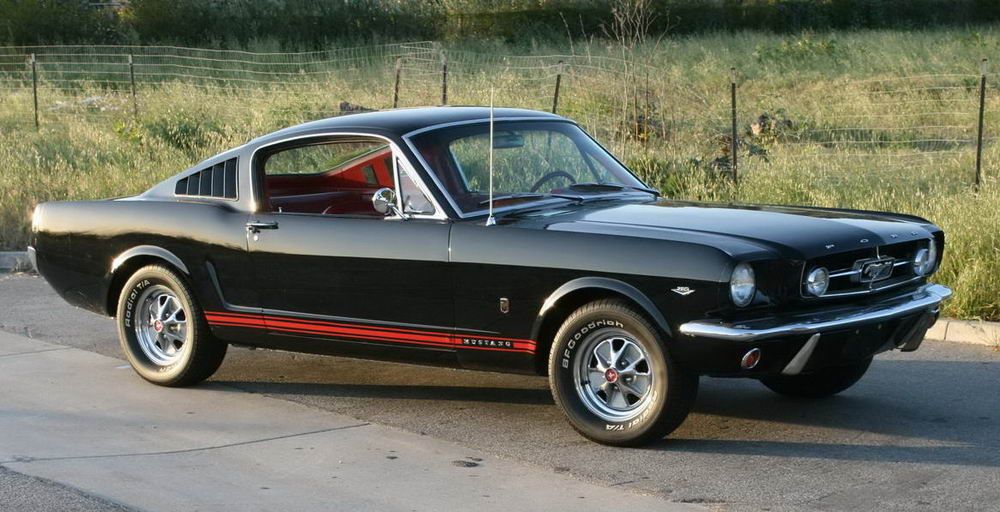
In 1965, about a year after the release of the Mustang, Ford decided that they were going to toughen up the Mustang line. So, they asked Carroll Shelby to make their pony car compete with GM's Chevy Corvette. In order to do this, Ford produced a normal white fastback without rear seats or hoods and sent them to Shelby so they could do whatever it was they wanted to do.

Shelby added and deleted several things to/from the Mustang. An aluminum intake was added to the engine to push it from 271 horsepower to 306. The Shelby headers came out in front of the rear wheels and the car had a Borg-Warner T-10 four-speed transmission. The exterior design had several changes that wasn't all too noticeable from far. The Mustang got a fiberglass hood with functional hood scoops. The side of the car got a blue stripe across the base of the body with the words "GT 350" behind the front 15" wheels. Also on the exterior, while all the original Mustang emblems were removed, Shelby added a little horse emblem on the driver's side of the grill. The suspension was a big part of the Shelby modifications. A larger front stabilizer bar, a 1" sway bar, adjustable Koni shocks and Koni rear traction bars. On the interior, the vacant rear seat area was the new spot for the spare tire. The interior only came in black. with a 3-spoke steering wheel. The Shelby also got competition seat belts. Only 562 Shelby Mustangs were made; 12 were race models; 36 were "R" models; 516 were street GT 350 models. These cars were all released by Carroll Shelby on January. 27, 1965. The price of the base Shelby's were about $4,000. They weren't quick and fast sellers, but they were bought by real car enthusiasts, which is who they were intended for in the first place.
http://www.muscularmustangs.com/images/67shelby2.jpg1967 Shelby
1966 saw a more profitable car, instead of just a fast limited production vehicle. The car lost it's one color only "take it or leave it" thought, by adding color options including black, red, green, and blue. The side stripe on the non-white color options were white. At first, the car was offered with a fiberglass hood, but complaints about poor fiberglass materials made Shelby redo the hood in steel. The tri-colored horse emblem on the grill was a bit smaller. Also, a new GT 350 gas cap was added. On earlier production vehicles, there was 15" wheels, but later they were removed and 14" wheels were added with the option of 14" 10-spokes. There was still the same 4-Speed transmission and same engine. Much of the suspension was the same as the normal production Mustangs, because they were another special addition to the car that wasn't needed to make a profit off of it. Ford heavy-duty shocks were used, with Koni shocks as an option. The interior was still in only black. There was a special chrome GT 350 center cap on the steering wheel. The spare tire was placed in the trunk and then later on in the production it was placed under the hood. There was three special versions of the Shelby Mustangs. One was a Supercharged option of the GT 350. Shelby only offered around 10 of these vehicles It gave the engine about 390HP. Another version of the Mustang was the Hertz Mustang. This version was added when Ford and Hertz rent-a-center made a deal to offer and special GT 350 Hertz edition. There was only about a thousand of the Hertz Mustangs made. On the Hertz edition Mustangs, many of them were black with gold stripes. There was also four other colors that included the gold stripes too. One other special edition of the Shelby Mustang was a special convertible model. None of these were sold to the public. Carroll Shelby gave 5 of the convertible models to friends and one to himself. One of those 6 were apparently destroyed, while the other 5 still exist. 3 or 4 racing models were made too.
http://www.muscularmustangs.com/images/69shelby8.jpg1969 Shelby
1967 saw a change in Mustang styling, making it more tough and muscular looking. And then, Shelby topped that with a even tougher looking appearance. Yet again, more delicious extras were taken away. The stang no longer came with Tri-Y headers, but now came with stock exhaust manifolds. The 289cu. in. engine rated at 306HP still remained there. Two functional scoops on the side of the car, two hood scoops and a rear spoiler were added to the car. The hi-beam lights in the center of the grill on the GT 350s were not aloud in some states, because state law mandated that they must be on the outer edges of the grill, which would actually let the engine breathe in more air Also, there was lights in the upper side scoops that many states had a problem with too. Only about 200 models left the factory with those lights as they were, before a few things were changed. On the passenger-side of the grill was a little horse emblem as had been on the driver's side in 65 and 66. On the rear on the car were two long Mercury Cougar taillights. Lots of fiberglass was also used. The hood, fenders, trunklid and a 3-inch extension to the cars length were all in fiberglass. The biggest edition to the Shelby line was the Mustang GT 500. This was the big-block version of the Shelby Mustang. The `67 Mustang's larger body made it easier to fit the huge 428cu in. police interceptor motor, which made 355 horses. The engine had a medium-riser aluminum intake manifold. The car came with power steering and power brakes. The car was known to have suffered when turning into corners at high speeds because of the extra weight in the front of the car. The car was offered with a C-6 Automatic Transmission or a Ford Toploader 4-Speed manual. This year didn't see any Hertz or any special Supercharged edition of the GT 350. The only special car was a Super Snake. 50 of them were supposed to be made, but weren't due to the high price that the car would have to cost just to make a bit of profit off of it. The car had a 427 Cobra motor that boasted 520HP. It included tuned headers, aluminum heads, aluminum intake, and a 4-Speed Transmission with a 4.11. The car was actually on eBay twice in 2002, but the reserve was never met, but bids reached $169,100. Around 2,000 GT 500s and 1,100 GT 350s were produced.

Ford didn't change much to the 1968 model from the 1967 model, but there was several differences between the naming of the 1968 model from any of the past Shelbys. Ford had by that time owned the Cobra name and wanted to get it out to people like they would have to do sooner or later anyway. So, they slapped it on the Shelbys. The actual word "Mustang" was not found on any of the Shelbys in the 1968. The name was changed from "Shelby Mustang" to "Shelby Cobra". Again, the GT 350 had a 302 and the GT 500 had a 427 engine, which became a 428 Cobra Jet later in production with the GT500KR ("King of the Road"), but this time, more luxurious items and more options were offered. On the exterior, there was two gigantic scoops of the fiberglass hoods. Right at the front edge of the Shelbys hood were the word Shelby spelled very openly. This wording was also on the rear spoiler. The grill sported two wide rectangular fog lights rather than the circular lights that were placed there in past years. On the sides of the cars, about an inch away from the front of the door, was a coiled-up snake. This snake emblem was also used when Ford introduced the SVT Mustang Cobra in 1993. Also, the taillights were basically the same as the `65 Thunderbird's. Much of the suspension was like a normal Mustang GT, with a few changes. Instead of just black, many colors were offered on the `68 Shelbys. Wood grain inserts were put on the doors and the dash, giving it a more luxurious look instead of the sporty interior. With this new model year, Shelby added a wide-spread amount of convertibles (compared to past years anyway). 404 GT 350 Convertibles, 402 GT 500 Convertibles, and 318 GT 500KR Convertibles were made. There was also a bunch more normal Shelby Fastbacks were produced. 1,253 GT 350 Fastbacks, 1,140 GT 500 Fastbacks, and 933 GT 500KR Fastbacks were made.

The Ford Mustang was completely redesigned in 1969. Now with this new model year, Ford used many of Shelbys old options on their other Mustang models. So, Shelby tried again to one-up everything else. On the exterior, Shelby used fiberglass to extend the whole nose of the car. The hood had 5 scattered around scoops; 3 pointing forwards and 2 pointing backwards. 2 other scoops were put right behind the door on the rear fender to cool the brakes. The front grill was very open. The only thing blocking the grill was a small little Cobra emblem. Instead of having the fog lights up on the grill, they were moved to under the bumper. The side stripe was moved to the middle of the door and went past the two wheel openings. A small cobra emblem was put just below the roof line on the Fastbacks and on the top rear of the front fenders on the Convertibles, which were again widely available. The rear spoiler was just a little taller than the `68s. Again, the Mustang had the sequential Thunderbird taillights. A large aluminum outlet was used around the dual exhaust system which came out right in the middle of the car. The wheels again were basically the same as they had been for a while. The interior was the same as the `68 models. The GT 350 got a standard 302 like it had for a long time, but also came with an optional 351. The GT 500 came with a 428 again. The remaining Shelbys from 1969 were sold as 1970 models. Ford only added two black stripes down the center of the car and a black front spoiler. 1,085 GT 350 Fastbacks, 194 GT 350 Convertibles, 1,536 GT 500 Fastbacks, and 335 GT 500 Convertibles were produced during the two years.

After 5 years, Ford and Carroll Shelby split. The Shelby Mustangs would no longer exist. This was the end of a very famous high performance car. Not much could be better for people who wanted to go really fast for really cheap. After this split of the two car companies, Shelby signed a deal with Chrysler to produce special performance editions of Dodge vehicles in 1982. Also, Carroll Shelby introduced the idea of the Dodge Viper to the Chrysler Corporation. The car's name was oddly enough based on a snake, much like the Shelby Cobra. Although Ford and Shelby went their separate ways, as of lately, they have come together to design the Ford Shelby Cobra and GR-1.

History of the Ford Mustang

1962 Mustang Prototype
1962 Ford Mustang Prototype
1963 Mustang Prototype
1963 Ford Mustang Prototype

In 1961, Lee Iacocca, vice president and general manager of Ford Division, had a vision. His vision was a car that would seat four people, have bucket seats, a floor mounted shifter, be no more than 180 inches long, weigh less than 2500 pounds, and sell for less than $2500.00. Out of this vision, the Ford Mustang was born. After many months of meetings, discussions and market surveys, funding was finally approved for the Mustang in September of 1962. On March 9, 1964 the first Mustang rolled off of the assembly line. Only 18 months had elapsed since the Mustang had been approved for production. In order to keep production costs down, many of the Mustang's components were borrowed from the Falcon, including most of the drivetrain. With a multitude of different interior, exterior, and drivetrain options, the Mustang would be able to be ordered as plain, or as fancy, as economical, or as fast, as the buyer wanted. In general, the Mustang was designed for everyone and was advertised as "the car to be designed by you".

The Ford Mustang was heavily advertised during the latter part of it's development. On April 16, 1964, the day before it's release, Ford ran simultaneous commercials at 9:30pm on all three major television networks, ABC, NBC, and CBS. The following day, April 17, 1964, people "attacked" the Ford showrooms. Everyone was in a frenzy to be one of the first to own the Mustang. Ford sold over 22,000 Mustangs the first day. By the end of the year, Ford had sold 263,434. By the end of the Mustang's first anniversary, April 17, 1965, Ford had sold 418,812 Mustangs. The Mustang had made a name for itself, and it was here to stay!!!


The First Production Mustang
First Production Ford Mustang
To Roll Off The Assembly Line


The 1964½, as it was later called, was available in only two models: the coupe and convertible. Both models featured a lengthened hood and shortened rear deck, chrome wrap-around bumpers, chrome grille with a running horse, and full wheel covers. Both models were available with a 170 cid, 101 horsepower, 6 cylinder engine, a 260-2V, 164 horsepower V-8, a 289-4V, 210 horsepower V-8 and, starting in June, a fire breathing, 4 barrel, solid lifter, 271 horsepower, 289 cid V-8 engine. The buyer had a choice of a 3 speed, 4 speed or automatic transmission, and a variety of rear end gear ratios. The interior featured "wall-to-wall" carpeting, front bucket seats or an optional front bench seat, rear bench seat, a sports car style steering wheel, floor mounted shifter, and full headliner. There were a total of 121,538 Ford Mustangs produced during the 1964½ model run.


1965 Mustang Convertible
1965 Ford Mustang Convertible
1965 Mustang 2+2 Fastback
1965 Ford Mustang 2+2 Fastback

1965 brought few changes for the Mustang. The biggest change was the availability of a new fastback model, which was to become the basis for Carroll Shelby's GT350. The 120 horsepower, 200 cid 6 cylinder engine replaced the 170 cid 6 cylinder, the 289-2V, 200 horsepower V-8 replaced the 260-2V, the 289-4V was upgraded to 225 horsepower, and the 289-4V hi-po remained unchanged. Other changes for the 1965 Mustang included: an alternator instead of a generator, relocation of the oil filler, integral power steering pump and resevoir (most 1964½'s had a remote mounted resevoir), a wire retaining ring was added to the gas cap, the horns were smaller and relocated, and the interior carpet was continued up the sides of the rocker panel and under the sill plate. A new interior option was added, the interior decor group (known as the pony interior), which featured special seat covers with running horses across the seat back, special interior door panes with integral arm rests and pistol grip door handles, five gauge instrument panel, woodgrain steering wheel, and woodgrain appliques on the instrument cluster, glovebox, and optionally on the center console. Another Mustang option introduced in April of 1965 was the GT equipment group. Available only with one of the two four barrel engines, the GT group included five-dial instrumentation, disc brakes, larger sway bars, quicker steering ratio, dual exhaust which exited through the rear valance panel, grill mounted foglights, and special lower body side stripes. A total of 559,451 Mustangs were produced for the 1965 model year.

1966 Mustang GT Coupe
1966 Ford Mustang GT Coupe
1966 Mustang GT Convertible
1966 Ford Mustang GT Convertible
1966 Mustang GT Fastback
1966 Ford Mustang GT Fastback

1966 brought even fewer changes for the Mustang than did its predecessor. Most of the changes for 1966 were in the form of cosmetic refinements. A new grille which featured chrome edged, horizontal inserts, replaced the honeycomb grille of '65. The chrome bars that extended horizontally and vertically from the running horse were deleted on the 1966 Mustang's grille. A new three fingered rear quarter panel ornament was used. The lower rocker panel moulding became standard equipment, as did backup lights, and a chrome hood lip moulding. The fuel filler cap no longer included the plastic Mustang emblem insert found on the earlier models. On the inside, the Mustang was treated to standard five gauge instrumentation, and "woven" vinyl seat inserts. The choices of available interior colors and styles increased to thirty four varieties, giving the buyer even more ways to personalize "their" Mustang. Production increased to 607,568 units for 1966.

1967 Mustang Convertible
1967 Ford Mustang Convertible
1967 Ford Mustang Coupe

1967 brought the first major restyling to the Ford Mustang. The Mustang was starting to grow up. The length and heigth were increased, 2.7" and .5" respectively. The wider body allowed for the installation of a tire smoking, 320 horsepower, 390 cid engine, the first big block engine in the Mustang. Among new options for the 1967 Mustang were the tilt-away steering wheel, an overhead console, power disc brakes, and an all new transmission, the FMX, which allowed fully automatic or manual shifting. The Mustang fastback's roof line was extended to the rear of the trunk. Interior trim options were decreased from 34 in 1966 to just 20 in 1967. Production for 1967 slipped to just over 472,000 units.

1968 Mustang GT Fastback
1968 Ford Mustang GT Fastback
1968 Mustang
California Special

1968 Ford Mustang California Special
1968 High Country Special
1968 Ford Mustang High Country Special

The 1968 Mustang was little changed from it 1967 counterpart. Most of the changes were in subtle refinements to the interior and exterior. New options for the 1968 Mustang included an AM/FM stereo radio, rear window defogger (coupe and fastback only), re-designed front power disc brakes, and the all new 302 cid engine. The 302-4V, 230 horsepower engine replaced the 289 Challenger Special of previous years. By December of 1967, the 289 engine was replaced entirely by the 302 version. Other changes included the deletion of the horizontal grille bars, the deletion of the F-O-R-D letters at the front of the hood, simplification of the quarter panel ornament, and many safety features were added. Due to increasing governmental regulations, the 1968 Mustang now included front and rear side marker lights, folding, flush mounted interior door pulls, and an energy absorbing steering column. There were several "region specific" models offered from various dealers. Two of the most noteable were the Mustang California Special, and the Mustang High Country Special. Total production for 1968 was 317,404 units.


1969 Mustang SportsRoof
1969 Ford Mustang SportsRoof

1969 brought another major restyling to the Mustang. The Fastback 2+2 was gone - replaced by the new SportsRoof model. The new Mustangs were almost 4 inches longer than their 67/68 predecessors, yet they retained the 108" wheelbase of the original 1964½. The base Mustang engine continued to be the 200 cubic inch six cylinder. New for the economy minded Mustang owner was an optional 250 cubic inch six. The base V-8 continued to be the 302-2V. The 351-2V and 4V entered the lineup for 1969. The 302-4V and the 390-2V were dropped, but the 390-4V remained. There were two special engines offered for 69, the Boss 302 and the Boss 429. Both engines were only available in two limited production units, so called, the Mustang Boss 302 and the Mustang Boss 429. New features for 1969 included quad headlights, front parking lights were now located behind the front valance panel, new quarter panel ornaments, side scoops and integral rear spoiler on the SportsRoof models, front seat back locks, and for the first time, the VIN number, in addition to being located on the driver's door, was also attached to the instrument panel, and visible through the windshield.

There were several new Mustang models offered during 1969. A little know model was the Mustang 'E'. It was basically a standard economy minded Mustang SportsRoof model with a six cylinder engine, a higher (lower numerically) ratio rear end with a large torque converter, and an automatic transmission. Air conditioning was not available on the 'E' model. A "Mustang E" insignia replaced the standard quarter panel ornament. Another new model was the Mustang Grande, which included the Interior Decor Group, an electric clock, special houndstooth check upholstery, and extra sound deadner.

Another new model was the Mustang Mach 1 which was only available with one of the five larger V-8 engines. It featured special interior trim, special carpet, and high back bucket seats. On the exterior, the Mach 1 featured a low-gloss black hood, non-functional hood scoop (except models equipped with the 428 Cobra Jet engine which had a "new for 69" shaker scoop), hood pins, dual racing mirrors,special side stripe, pop-open gas cap, and dual exhaust ending in chrome, quad outlets. The Mustang Mach 1 also included the "Handling Suspension" and an additional 55 pounds of sound deadner and insulation materials.

Another new model for '69 was the Mustang Boss 302. Built mainly to qualify the Mustang for the SCCA (Sports Car Club of America) Trans-Am series. The Boss 302 included a special 290 horsepower, 302 engine, 4 speed transmission, 16:1 ratio steering box, and a 3.50:1, staggered shock rear end. The exterior featured a low-gloss, black hood and deck lid, Boss 302 "C" stripes, front spoiler, flared fenders and Magnum 500 wheels with F60x15 tires. All of the optional Mustang interiors were available on the Boss 302, however, most of them were equipped with the black, standard Mustang interior.

The biggest and baddest of the Boss's, the Mustang Boss 429, was also introduced in 1969. Primarily built to satisfy NASCAR requirements, the Boss 429 Mustang featured a Semi-Hemi 429 powerplant. To compensate for the massive engine, the front shock towers were moved out one inch, and the front A-Arms were lowered one inch. The Boss 429 featured a huge hood scoop (the largest ever offered on the Mustang), front spoiler, flared fenders, dual racing mirrors, and F60x15 tires, mounted on chrome, Magnum 500 wheels. The interior featured the Mustang interior decor group, comfortweave bucket seats, and console. The Boss 429 also featured a competition suspension, rear stabalizer bar, power front disc brakes, power steering, engine oil cooler, trunk mounted battery, and a 3.91:1, traction lock rear end.

There were a total of 299,824 Mustang's built in 1969.

1970 Mustang Coupe
1970 Ford Mustang Coupe
1970 Mustang Grande
1970 Ford Mustang Grande

1970 saw no major changes to the Mustang lineup. Most of the changes were in the way of subtle refinements. The headlights became dual units again instead of the quad units used in 1969, front side marker lamps were moved up onto the fenders, the quarter panel "scoops" were deleted, and the rear taillights were now recessed into their housings. On the inside, high back buckets became standard equipment with the seat back release moved to the lower part of the seat, a new "oval" steering wheel (supposedly to ease entry and exit), and the ignition switch was moved to the steering column which locked the steering wheel when turned to the off position. The engine lineup changed slightly for the 1970 Mustangs. The 390 was dropped and the 351-2V Cleveland and 351-4V Cleveland replaced the 351 Windsor models of previous years. The Mach 1, Boss 302, and Boss 429 were all available in 1970. Total Production for 1970 was 190,727 units.

1971 Mustang Coupe
1971 Ford Mustang Coupe
1971 Mustang Grande
1971 Ford Mustang Grande
1971 Mustang Mach 1
1971 Ford Mustang Mach 1

1971 saw another major restyling change for the Ford Mustang. It was also to be the last restyling for the first generation Mustang. Introduced late in August of 1970, the new Mustang was more than two inches longer and almost two and a half inches wider than it's 1970 predecessor. For the first time since the Mustang's inception, the wheelbase was extended one inch to 109". The 200 cid 6 cylinder was dropped along with the 428, the Boss 302, and the Boss 429. New engines for '71 were the Boss 351, the 429, and the Ram Air 429. The Mustang Boss 351 produced 330 horsepower, while both 429 engines produced 370 horsepower.

On the exterior, the famous Mustang corral returned. A new wide chrome strip on the edge of the front fenders and hood was borrowed from the 1969 Shelby's. The long hood now turned up at the windshield to cover the hidden wipers. Large, bold, triple lens tail lights appeared on the rear of the new Mustang. Flush mounted door handles replaced the earlier surface mounted units.

The interior featured standard high-back buckets, a mini console, and an all new instrumentation layout. Power windows were offered for the first time. The Mustang Mach 1 continued to be offered for '71. It was available with any of the V8 engines. A special honeycomb grille and color keyed front bumper were unique to the Mach 1 model. The chrome hood and fender mouldings were replaced with color keyed trim. "Mach 1" decals were placed on the fenders and deck lid and a special black or argent lower body side paint was used.

New for 1971 was the Mustang Boss 351 which replaced the Boss 302 and Boss 429. The Boss 351 featured a special 330 horsepower 351-4V Cleveland engine. The Boss 351 featured a blacked out NASA scooped hood with twist type locks and special body side stripes. The Boss 351 included a competition suspension with staggered rear shocks, a four speed transmission with a Hurst shifter, power front disc brakes, dual exhaust, and 3.91:1 traction lock rear end.

There were a total of 149,678 Mustangs built in 1971.

1972 Mustang Coupe
1972 Ford Mustang Coupe
1972 Mustang Convertible
1972 Ford Mustang Convertible
1972 Mustang Mach 1
1972 Ford Mustang Mach 1

Since the Mustang had undergone a major restyling in 1971, the 1972 Mustang models saw no big styling changes, only minor cosmetic ones. Probably due to increasing governmental fuel economy regulations, all of the Boss cars were dropped from the 1972 lineup. The Boss 351 and both versions of the 429 engine were dropped. During the early part of '72, a special 351HO model was offered. It featured a low compression version of the Boss 351 engine, with a special high-lift cam, mechanical lifters, forged aluminum pistons and a special 4-barrel manifold. The only "performance" model that remained for the entire '72 model year was the Mustang Mach 1. The Mach 1, like all other '72 models, were virtually unchanged.

Production for 1972 topped out at 125,093.

1973 Mustang Coupe
1973 Ford Mustang Coupe
1973 Mustang Convertible
1973 Ford Mustang Convertible

1973 brought the last year of the "big" Mustang. It was to be replaced by a smaller, lighter breed, therefore, most of the changes for '73 were merely cosmetic. A large, square, chrome headlamp bezel appeared, as did chrome trim around the tail lights. A color keyed Urethane front bumper replaced the chrome units of the previous years. The front parking lights were now placed vertically in the front grille. A new, grained, black applique with bright trim was placed on the rear body panel between the tail lights. This was replaced with a honeycomb style on the Mustang Mach 1 and Mustang Grande models. The 1973 Mustang convertible was to become the last Mustang convertible for many years. There were a total of 134,867 Mustangs produced in 1973.